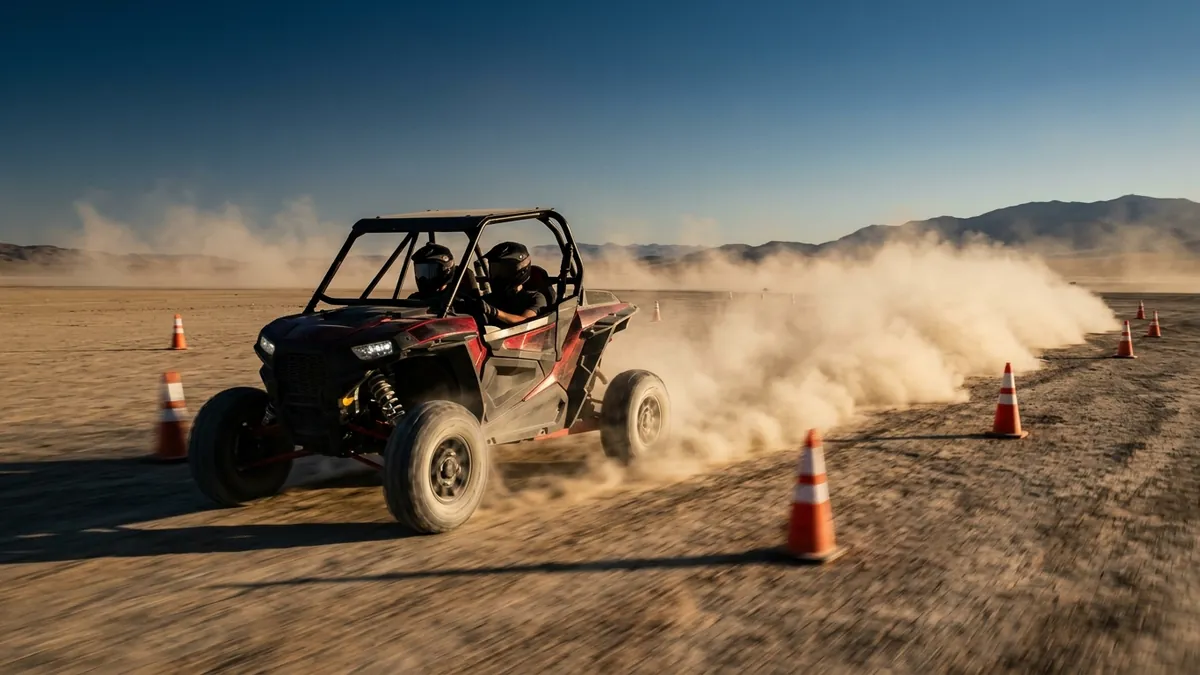
UTV Speed Limiters Explained: Off-Road Use Only
Which speed limiters UTVs use, why they exist, the risks of adjusting them and when it makes sense for racing or private land. Off-road use only.
The limiters a UTV can have
Off-road Off-road and competition use only. Everything in this article applies only to competition vehicles and to vehicles used exclusively on private land or closed courses that are not driven on public roads. The customer is responsible for complying with local regulations, including EPA and CARB rules in the US, provincial and federal rules in Canada, and the regulations of each country in Latin America and Brazil. Modern UTVs leave the factory with several layers of limitation built into the ECU. Some cap top speed, others limit speed under certain conditions, and others restrict engine rpm. For a racer preparing a machine for a desert event, or a ranch owner who uses a side-by-side only on private land, it is reasonable to ask what each limiter does and whether it should be changed. This article explains the common types, why they exist, the real risks of changing them and our position. The exact strategies depend on the brand, model, model year and market. The most common are: Top-speed limiter. A fixed maximum vehicle speed, enforced by the ECU through throttle, ignition or fuel control. Gear or range limits. A lower maximum speed in low range, in reverse or in certain drive modes, to protect the transmission and keep the vehicle controllable. Seat belt limiter. On many recent UTVs, if the driver's belt (and sometimes the passenger's) is not buckled, speed is held to a low value. Key and mode limits. Some machines offer a restricted key, a "work" or "eco" mode, or a learner mode that reduces speed, power or throttle response. Rev limiter. The engine rpm cap that protects the engine and, with a CVT, also defines the top of the usable range.
Why they exist
Limiters are not there by accident. Manufacturers fit them for several reasons: Occupant safety. A UTV has a much higher center of gravity than a race car and can roll over. Seat belt limiters exist because unbelted occupants are at far greater risk in a rollover. Regulation and standards. Industry standards and the rules of each market influence how fast a machine may go, especially machines sold for recreational or youth use. Drivetrain protection. A CVT belt and the gearbox have limits on speed, heat and load. Range limits keep the belt from running fast in a ratio where it overheats. Tires and chassis. Factory tires, brakes and suspension are specified for the factory top speed. When adjusting them can make sense Adjusting a top-speed limiter or a rev limiter can make sense in specific cases: A competition vehicle prepared for desert racing, short course or rallies, under the rules of a sanctioning body. A machine used exclusively on private land, such as a ranch, where the owner controls access and conditions. A closed course or track day, with the vehicle transported there and never driven on public roads. Even then, an adjustment only makes sense if the rest of the vehicle is ready for it.
The real risks
Belt and CVT. Higher speed means higher belt speed and temperature. A belt failure at speed can damage the clutches and the drivetrain. Clutching has to be reviewed with any change. Transmission and driveline. Gearboxes, axles and differentials were designed around the factory speed and power. Brakes. Kinetic energy grows with the square of speed: going from 60 to 75 mph (about 97 to 121 km/h) increases it by more than 50 percent. Factory brakes may not cope with repeated stops from higher speeds. Tires. Every tire has a speed rating, and many off-road tires are rated well below what a modified UTV can reach. Check the rating of your tires before going any faster. Roll cage, harnesses and nets. At higher speeds the consequences of a rollover are more serious. Competition-grade harnesses, window nets, a cage suited to the use and helmets become essential. A checklist before any change Confirm the vehicle's use: competition, private land or closed course only. Check tire speed ratings, brake condition and wheel bearings. Inspect the belt, clutches, axles and suspension. Review the safety equipment: cage, harnesses, nets, helmets and fire extinguisher where the rules require it. Plan clutching and rpm limits together with the calibration, not as separate changes.
Our position
We offer limiter adjustments only for competition vehicles and for vehicles used exclusively on private land or closed courses that are not driven on public roads. Before we work on a file we ask what the vehicle is used for, and we can decline any request that does not fit that use. Our terms and conditions set out these conditions. We recommend keeping safety systems in place. We do not modify safety strategies such as the seat belt limiter on vehicles driven on public roads, and even for off-road use our recommendation is to keep the seat belt strategy active: being buckled in is what keeps occupants inside the cage in a rollover. The same goes for temperature and engine protection strategies, which we keep active on every file. When a change is appropriate, we treat it as part of the whole calibration: rpm limits, clutching, temperatures and the fuel the vehicle will run on. For model-specific details, see our guides to the Can-Am Maverick X3 and the Polaris RZR , and our off-road race services . An overview of the machines we cover is on UTV and side-by-side tuning . Reprogramming the ECU can affect the manufacturer's warranty. We always keep a copy of your original file so the stock calibration can be restored. Off-road and competition use only. Everything in this article applies only to competition vehicles and to vehicles used exclusively on private land or closed courses that are not driven on public roads. The customer is responsible for complying with local regulations, including EPA and CARB rules in the US, provincial and federal rules in Canada, and the regulations of each country in Latin America and Brazil. Preparing a race machine? Create an account and upload your original read file with the vehicle's intended use, or contact us first.