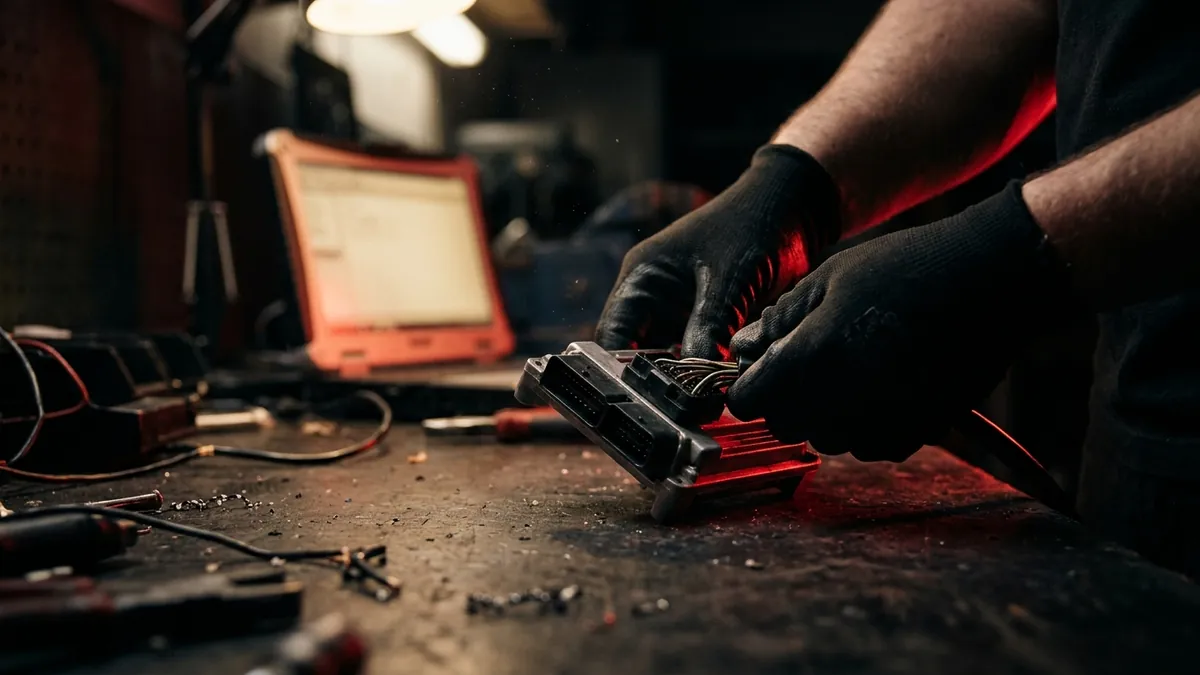
What Is a Motorcycle ECU Flash? How It Works
Learn what a motorcycle, ATV or UTV ECU flash changes: fueling, timing, throttle maps and limiters, what it cannot do, and how the file service works.
What the ECU actually does
Tech Every modern motorcycle, ATV, side-by-side, personal watercraft and snowmobile runs on a small computer that decides, thousands of times per second, how much fuel to inject, when to fire the spark plug and how far to open the throttle. That computer is the ECU (engine control unit). An ECU flash is the process of rewriting the calibration stored inside it, so the engine follows a new set of instructions instead of the ones it left the factory with. This guide explains what is actually inside that calibration, what a flash changes, what it does not change, and how the process works from reading the original file to riding with the new one. The ECU reads sensors and makes decisions based on tables, usually called maps. The inputs are things like engine speed (rpm), throttle position or twist-grip request on ride-by-wire bikes, intake air pressure or airflow, air and coolant temperature, gear position and, on many engines, one or more oxygen sensors in the exhaust. The outputs are injector pulse width, ignition timing, electronic throttle opening, idle control, cooling fan, and on turbocharged machines the wastegate or boost control. Most of the logic is a lookup: at this rpm and this load, inject this much fuel and fire the spark at this angle. Around those core maps sit many other tables and switches: rev limiters, speed limiters, cold-start enrichment, correction factors for temperature and altitude, traction control and riding modes, protection strategies for overheating and knock, and diagnostic routines that set fault codes.
Why factory calibrations leave room
A factory calibration has to work for every unit of that model, sold in many countries, ridden by people who may never check their oil, burning fuel of unknown quality, at sea level and at altitude. It also has to pass noise and emissions certification in each market. The result is a set of maps that is deliberately conservative in some areas and shaped by test cycles in others. Common examples are a lean mixture at light throttle that makes the bike snatchy at the on/off transition, a soft or delayed throttle response in some riding modes, torque reductions in the lower gears, and rev or speed limits set for reasons other than mechanics. A flash does not invent power out of nothing. It re-balances those compromises for one specific use: a track bike, a dune UTV, a race quad, a lake boat. That is why the same model can get different calibrations for different riders. What a flash typically changes Fueling: air-fuel targets across the rpm and load range, especially at part throttle and full load, and the corrections needed after an intake or exhaust change. Ignition timing: spark advance tuned to the fuel you actually use, always keeping margin against knock. Throttle maps: on ride-by-wire engines, how the throttle body responds to the grip or pedal in each mode. See ride-by-wire throttle maps explained . Limiters and torque reductions: rev limit adjustments within safe mechanical limits, and gear-based torque cuts where the use case allows it. Boost control: on turbocharged UTVs and snowmobiles, boost targets kept inside what the turbo, intercooler and fuel system can support. Features: on supported ECUs, functions such as quickshifter, auto-blipper or launch control . How much a rider feels depends on the model, the fuel, the hardware and what was holding the engine back in the first place. On some engines the biggest gain is drivability rather than peak numbers; on others, especially turbocharged ones, the change is easy to feel. We do not publish fixed horsepower figures per model, because an honest number depends on the individual machine and the dyno it is measured on.
What a flash does not change
Off-road and competition use only. Speed limiter changes and any emissions-related modification (decat, O2 sensor, AIS/PAIR, EVAP) are offered only for competition and off-road vehicles that are not ridden on public roads. You are responsible for complying with local rules: EPA and CARB in the United States, federal and provincial regulations in Canada, and the regulations of each country in Latin America and Brazil. Software cannot change compression, cam timing, valve springs or the strength of a connecting rod. It cannot make a worn engine healthy, fix a slipping CVT belt or replace a clogged air filter. A good calibrator also leaves the ECU's protection strategies working: knock control, overheat protection and the plausibility checks that catch a faulty sensor or a stuck throttle are there for a reason. If an engine needs hardware to reach a goal, the honest answer is to say so, which is the difference explained in Stage 1 vs Stage 2 . How the process works, step by step Read the ECU. The original file is read with a tool such as KESS3 , through the diagnostic port (OBD) where the model allows it, or on the bench with the ECU removed. Some ECUs can only be read on the bench or in boot mode. Save the original. The untouched file is stored before anything else. It is your way back. Upload it to your account. You create a Race ECU account , choose the vehicle and the options, and upload the file. Calibration. Our calibrators identify the software version, modify the maps for your setup and correct the checksums so the ECU accepts the file. Write and test. You write the modified file back, clear any stored codes, check that the engine idles and warms up normally, and ride it gently before using full power. The details are on how it works , and prices per vehicle type are on the pricing page . For bikes that need fine adjustment, such as heavily modified engines or race machines, a custom dyno remap lets the calibration be checked and refined under load.
Is it reversible? And what about the warranty?
Because the original file is saved, most ECUs can be returned to stock by writing it back, as long as the ECU still allows writing. That said, a flash can affect your factory warranty, and a dealer may be able to tell that the ECU has been written even after the original is restored. A dealer software update can also overwrite a flash, so tell your calibrator before any update. We would rather you know this up front than be surprised later. More on this in motorcycle remap myths . Which machines can be flashed? Most fuel-injected powersports engines from the last decade or so can be flashed, but support depends on the exact ECU and software version, not just the model name. We work on motorcycles , ATVs and quads , UTVs and side-by-sides , personal watercraft and snowmobiles . If you are not sure whether your ECU is supported, send us the details before reading it. After the flash A tuned engine rewards good habits: quality fuel of the grade the file was made for, clean filters, fresh spark plugs and sensible oil intervals. Our maintenance guide after ECU tuning covers the details. Ready to start? Create your account and upload your original file, or contact us with your vehicle, ECU and setup and we will tell you what is possible.